
The lights come back on, and the first feeling is relief. That is fair, and in most homes it is the end of the story. A few systems, though, do not always come back the way they went off. Power that flickers during restoration, or that returns at low voltage for a few minutes, is hard on motors and control boards. This walk-through covers what to look at once the power is on, in a sensible order. It also helps you tell what will settle down on its own from what needs a call.
A recent history
Triangle homeowners have had practice. Local news reports put the July 2026 outage at 26,000 to 27,000 Duke Energy customers across the Triangle, with Durham hit hard after a tree brought down transmission lines. The August 2023 storms left more than 18,000 Durham County customers dark and closed schools for days. Tropical Storm Debby in 2024 took out power for thousands more. Each one ended with the same quiet question in thousands of houses: is everything all right now?
Before anything else
- Notice what you smell. A gas smell anywhere means leave the house, keep the door open behind you, and call the gas utility from outside immediately.
- Notice what is hot. A burning or hot plastic smell at the panel, an outlet, or a piece of equipment means turn that breaker off and leave it off.
- Look at the panel. A breaker that tripped during the restoration can be reset once. One that trips again is protecting a circuit with a fault on it, and that circuit should stay off until a licensed electrician has looked.
- Stay clear of standing water near any appliance or the panel until it is gone.
Bringing the heating or cooling back
Give the system a few minutes before you judge it. Air conditioners and heat pumps have a built-in delay after power returns so the compressor does not restart under pressure. If the thermostat is still blank after that, try its batteries and the breaker for the air handler. Then set the thermostat a few degrees past room temperature and listen. A steady hum with the outdoor fan turning is what you want. A hum with no fan, a loud click that repeats, or a unit that starts and stops within a minute points to a capacitor, contactor, or control board that took a hit during the flicker, and these are the calls we take most in the days after a storm. If the system runs but the house does not cool or warm over the next hour, our air conditioning repair and heating teams can sort it out. After an ice storm, check that the outdoor unit is not encased in ice or buried under limbs.
The water side of the house
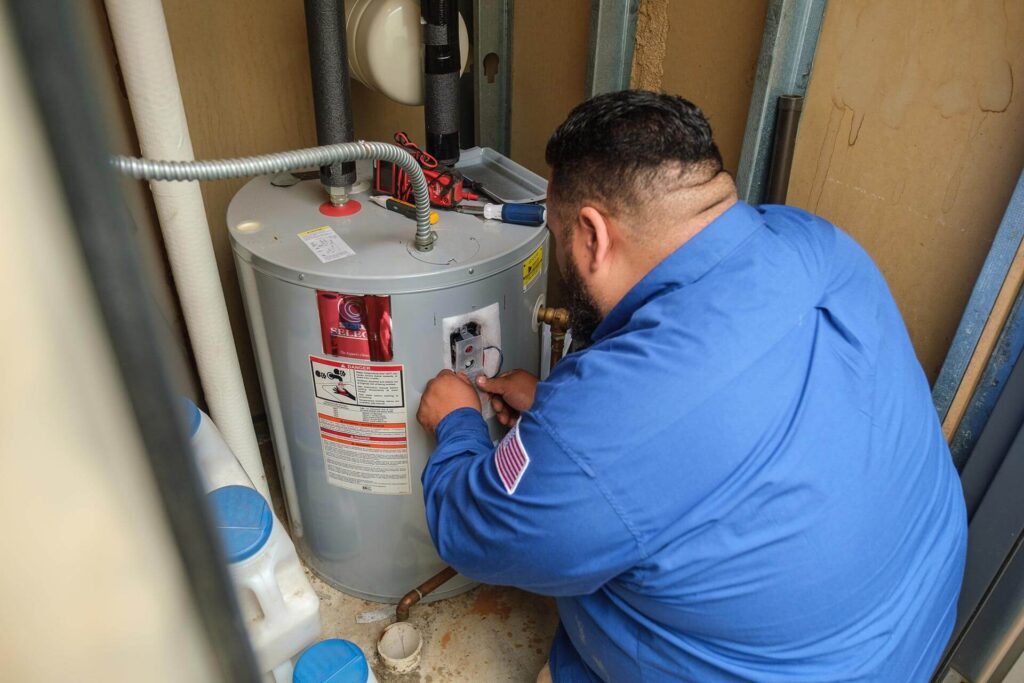
An electric water heater usually comes back on its own, but some units have a high-limit reset behind the upper access panel that trips after a power event. If there is still no hot water an hour later, let us check that rather than opening the panel yourself near live wiring. A gas heater with electronic ignition relights on its own; one with a standing pilot may need relighting per the label on the tank. Give the tank an hour to recover, and look at the floor around its base. Pressure swings during an outage can turn a small drip into a visible one, and a wet spot under an older tank is worth knowing about now.
If your home is on a well, run a cold tap for a minute or two once the pump has power. Air in the lines is normal after an outage and clears quickly. Pressure that will not build, or a pump that cycles rapidly, means the pressure tank or switch needs attention, and our well pump team handles both. If you have a sump pump, it sat idle while the storm dumped rain, so the pit may be full. Lift the float or pour water in and confirm it runs. A pump that hums without pumping, or that has not started with water around it, needs sump pump service before the next rain, and this is the moment many homeowners decide a battery backup pump is worth having.
The refrigerator and freezer
USDA guidance is simple here. A refrigerator holds a safe temperature for about four hours with the door closed, and a full freezer for about 48 hours, or 24 if it was half full. Anything in the refrigerator that spent longer than four hours above 40 degrees should go. Frozen food that still has ice crystals can be refrozen; food that thawed fully should not be.
If you ran a portable generator
Shut it down, let it cool completely, and then refuel it and store it with the fuel treated or drained, because stale gasoline in the carburetor is the usual reason a portable will not start the next time. If it ran for more than a day, note that for its next oil change. And as always, keep it far from windows and doors whenever it runs; carbon monoxide from generators is a danger every storm season.
When to give us a call
Most of what you find on this walk-through will be fine. The rest falls into a few clear categories: a system that will not restart, a breaker that keeps tripping, a burning smell, water where it should not be, or a well pump that will not build pressure. Any of those is a reason to reach out rather than wait. Happy Home Services has served the Triangle since 1955, and you can reach us 24/7 by phone or website chat, schedule online, or use our emergency plumbing page for water problems. Whatever the storm left behind, the repair comes with honest, upfront pricing with a 100% money-back guarantee.