
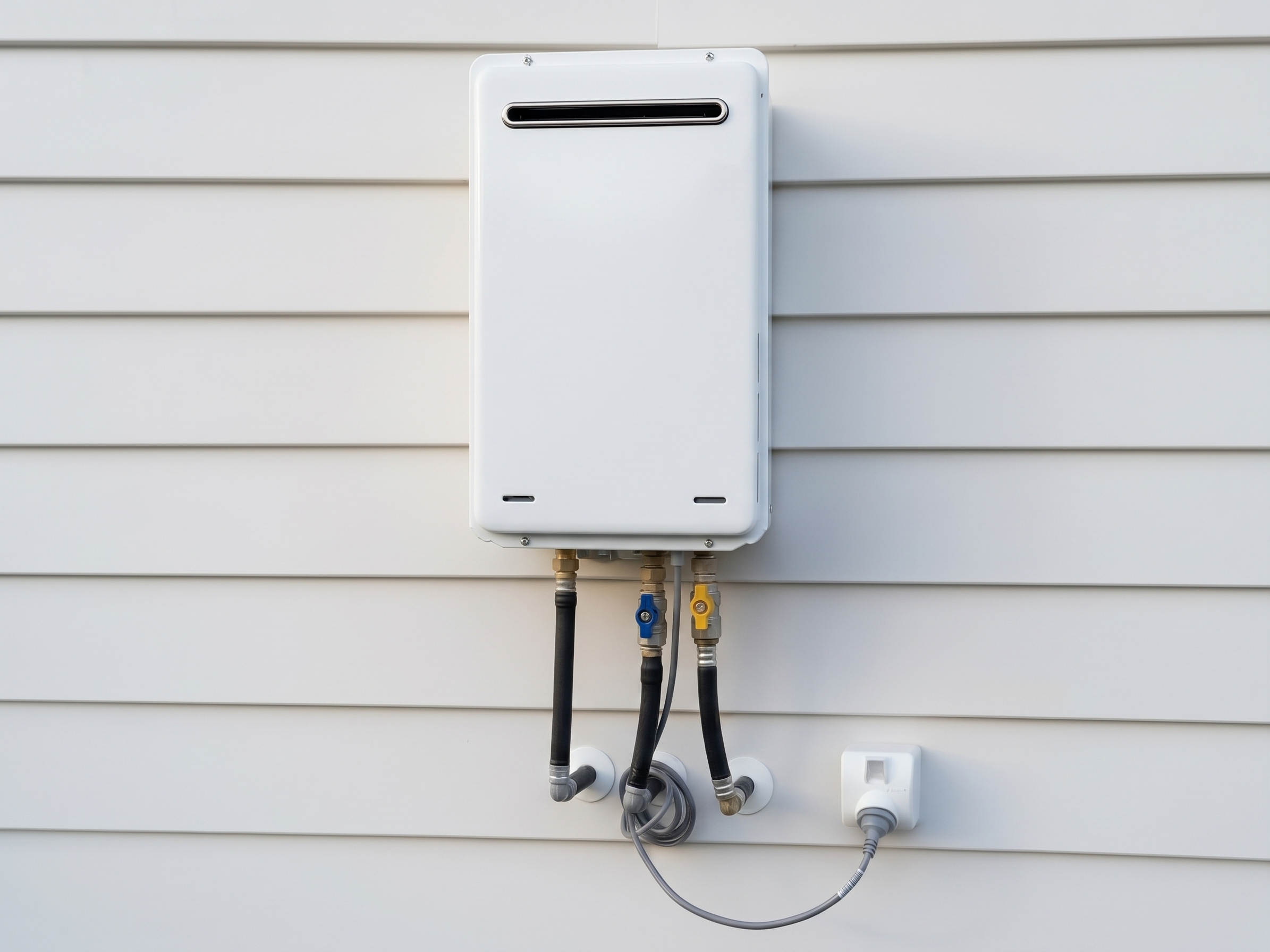
The case for a tankless water heater is usually made with efficiency percentages and lifespans, and those matter. Most Durham households notice hot water in smaller moments, though: the third shower on a school morning, the dishwasher running while someone is in the tub, the week the in-laws stay. So this post follows an average Triangle household through a single day twice, once with the conventional tank heater most homes have and once with a tankless unit, and lets the moments make the case. The numbers come at the end, along with who should switch.
6:30 a.m., the showers
With a tank heater, the first shower is fine, the second is fine, and the third arrives as the 50-gallon tank empties and the water turns lukewarm, because the tank cannot heat water as fast as three showers use it. With a tankless unit, there is no tank to empty, since the heater warms water as it flows through, so the third shower is as hot as the first, and the only limit is how many fixtures can run at once. For a household of teenagers, this moment is often a contributing factor for making the switch.
9:00 a.m., the empty house
With a tank heater, the house empties for work and school and the heater keeps working anyway, reheating 50 gallons every time they cool, all day. That standby loss is the largest part of a tank heater’s operating cost. With a tankless unit, the heater is off. It runs only while a hot tap is open, which is where the Department of Energy’s estimate comes from: for homes using about 41 gallons of hot water a day or less, a tankless heater is 24 to 34 percent more energy efficient than a conventional tank, and 8 to 14 percent more efficient for homes using around 86 gallons a day.
6:00 p.m., dinner and the dishwasher
With a tank heater, the dishwasher fills while someone runs a bath upstairs, and the bath cools as the tank shares what it has. With a tankless unit sized for the household’s peak use, both run hot. The word sized matters, and it is where the one limitation belongs: a tankless heater’s flow rate depends on how much it has to raise the water’s temperature, and the water arriving at a Durham home in January is a good deal colder than in July. A unit sized for a summer evening can run short on a January morning when two showers and the dishwasher overlap, so the unit is sized for the cold-water season and the peak, not the average, and that sizing is part of every estimate.
The week the guests come
With a tank heater, a house that hosts five extra people for Thanksgiving learns exactly how many showers a tank holds. With a tankless unit, the guests shower when they like. This is also the week a tank heater’s age tends to show, because a tank past ten years working at capacity is the one most likely to give out on a holiday.
The garage floor and crawl space
Many Durham water heaters sit in garages or crawl spaces on Piedmont clay, and a tank on the floor of either stands in water when a storm floods the space. A tankless unit is about the size of a carry-on suitcase and hangs on the wall, above the level that water usually reaches and off the floor a tank would flood. It also lasts about 20 years with regular maintenance, roughly twice a tank heater’s 8 to 12, so one unit serves the period in which a tank would be replaced twice. The maintenance is a yearly descaling flush, which our water heater flush service covers, and skipping it shortens the life and voids many warranties.
The two questions that decide the switch
The first is gas. A gas tankless heater draws several times the gas a tank heater does while it runs, so it often needs a larger gas line and its own venting, which is plumbing work our tankless water heater installation team handles. The second is electricity for homes without gas service. An electric tankless heater draws a large amount of current when it fires and frequently needs new circuits or a panel with more capacity than an older Durham home has, and that evaluation belongs to a licensed electrician before the heater is chosen. Financing is available for either type.
Who should switch, and who should not?
The switch makes sense for a household that runs out of hot water, a home with gas service, a homeowner staying long enough for the lower operating cost and the longer life to repay the premium, and a house whose tank sits in a garage or crawl space that has flooded. It makes less sense for a small household with modest hot water use and a tank in a dry interior closet, for a home on very hard well water without treatment, since scale collects in a tankless heat exchanger faster than in a tank, for a home without gas and with an older panel unless the electrical upgrade is already planned, and for a homeowner who expects to sell within a few years. In those cases a new tank heater, installed well, is the sensible choice, and our water heater installation team will say so.
Deciding before the garage floor decides
Happy Home Services has been Durham’s trusted heating and air experts since 1955. If your tank heater is past ten years, or if the 6:30 a.m. moment above sounds familiar, reach us 24/7 by phone or website chat. The technician will measure the household’s peak hot water use, check the gas line, and lay out the tankless and tank options side by side with honest, upfront pricing with a 100% money-back guarantee.