
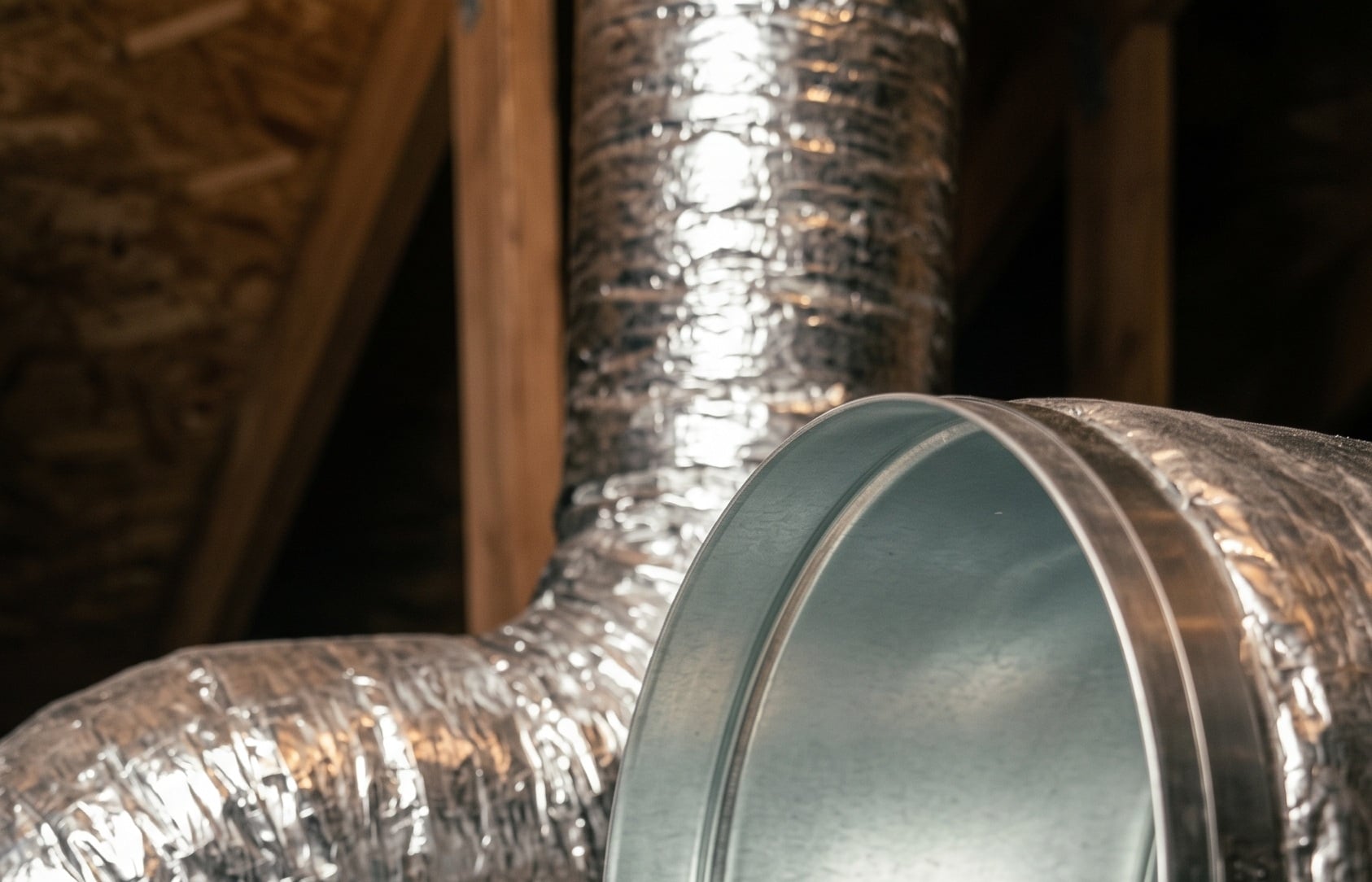
Duct replacement is a recommendation that often lands as a surprise when its needed, because nobody thinks about the ducts until a technician does. This post describes three kinds of Durham homes where the recommendation frequently comes up. For each it covers what the ducts are doing wrong, how we’d know, and what replacement would involve. The three are drawn from situations we see often across the Triangle, and one of them probably describes yours if a technician has mentioned your ductwork.
The 1990s house with flexible duct in the attic
The first home is a two-story built during the Triangle’s growth years, with the air handler and all the ductwork in the attic. Flexible duct was the standard, and it has spent thirty summers in air that reaches 130 degrees. The liner has gone brittle, the insulation jacket has sagged off whole runs, and the joints that were taped in 1994 have separated. The homeowners’ complaint was the one we hear most: the upstairs bakes in July while the downstairs is comfortable, and the power bill has climbed while the system seems fine. An airflow measurement showed a large part of the cooled air leaving the ducts before it reached a register, and a camera showed liner that crumbled when touched. Sealing was not an option, because there was nothing sound to seal. Replacement meant a new duct design sized for the equipment, new insulated runs, and balanced registers, and the result was an upstairs that finally held the same temperature as the hall and a system that stopped running long cycles to compensate.
The older home with metal duct in a damp crawl space
The second home is older, in one of Durham’s established neighborhoods, over a crawl space on Piedmont clay that stays damp for weeks after every wet spell. The ductwork was metal, installed decades ago, and the crawl space had done to it what damp clay does: the seams had rusted, the hangers had corroded and let runs sag into the mud, and the insulation wrap had fallen away. The complaint here was different, a musty smell from the vents that duct cleaning improved for a season and did not resolve, and dust that returned days after the house was cleaned. The camera showed growth inside the runs and daylight at the seams, and the smell was the crawl space’s air being pulled into the system and pushed into the bedrooms. Replacement here meant new runs hung clear of the ground and sealed against the crawl space, and for this household the most noticeable change was the air rather than the temperature.
The addition that never got enough air
The third home is any house with a room added later, a sunroom, a bonus room over the garage, a converted porch, where the builder extended the existing ductwork rather than designing for the new space. The room has never cooled or heated properly, the family runs a window unit or a space heater in it, and lowering the thermostat over-conditions the rest of the house without helping. The problem is not failed material but an undersized layout. Replacement in this case is often partial: a redesigned run to the addition, sometimes a separate zone, and a look at whether the equipment can carry the added load. HVAC zoning solves the addition and the two-story upstairs problem alike, and it is planned alongside the duct work rather than after it.
How we tell which home you have
Each of the three shows itself in the same two measurements. An airflow and static pressure reading shows how much conditioned air is being lost and whether the layout delivers enough to each room, and a camera inside the runs shows the condition of the material. Those two tell whether the answer is sealing, which recovers lost air from sound ducts, cleaning, which removes what has collected in sound ducts, or replacement, which is the answer when the material itself has failed or the layout was never right. A technician who recommends replacement should be able to show you the readings and the camera view, and ours will.
What the job involves
A duct replacement begins with a design rather than a demolition. The technician measures the rooms, calculates the airflow each needs, and lays out a system sized for the equipment. The old duct comes out of the attic or crawl space, the new runs go in with sealed connections and, in a crawl space, hung clear of the clay, and each register is balanced so every room gets its share. In most homes the work takes one to three days, the living space is disturbed very little because the work happens above the ceiling and below the floor, and the technician measures the finished system’s airflow before leaving. Our air duct installation page describes the service, and financing is available.
When to do it
The sensible time is alongside a heating and cooling replacement, since a new system on failed ducts wastes part of what it cost, and the technician who quotes the equipment quotes the ducts on the same visit. When the ducts are failing but the equipment has years left, the replacement stands on its own, and the comfort and the bill are the return. Spring and fall are the practical seasons, when the attic is not 130 degrees.
Finding out which home is yours
Happy Home Services has been Durham’s trusted heating and air experts since 1955. If one of the three homes above sounds like yours, reach us 24/7 by phone or website chat to schedule an evaluation. The technician will measure the airflow, look inside the ducts, and tell you plainly whether sealing, cleaning, or replacement fits, with honest, upfront pricing with a 100% money-back guarantee before any work is scheduled. Members of the Happy Home Service VIP Club receive up to 25 percent off repairs.