

Find, Test, Label, and Share Your Main Water Shutoff: The 5 Minute Drill
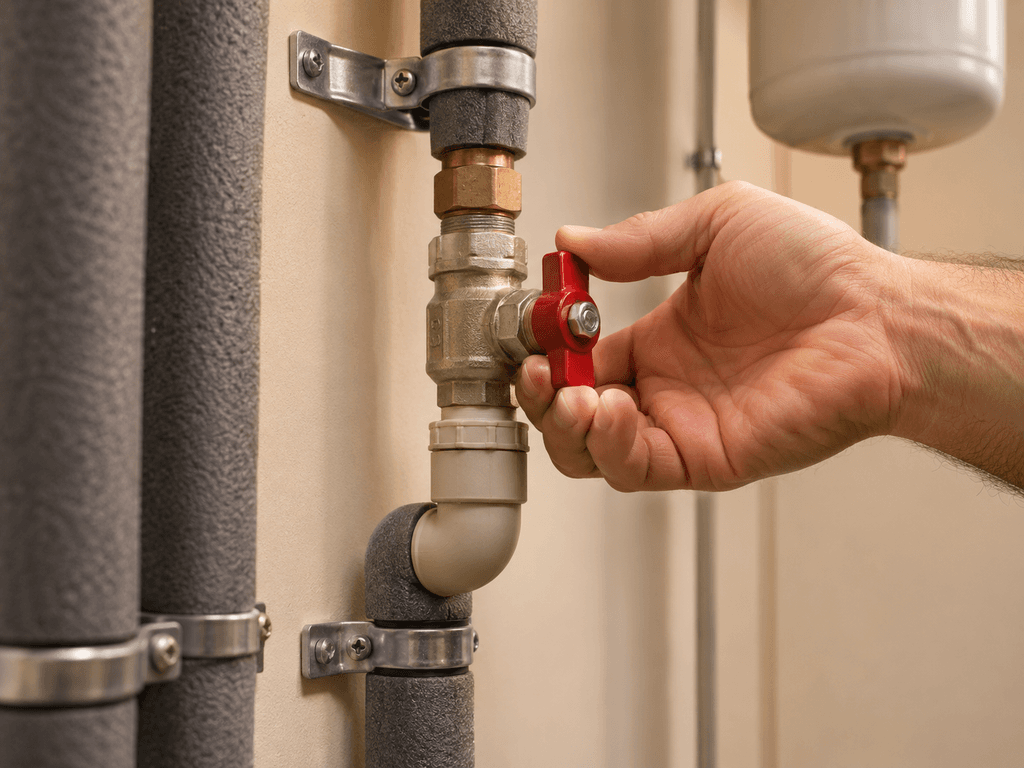
Five minutes with your main water shutoff valve, once a year, decides how much damage the next burst pipe or failed supply line does. The drill has five steps: find the valve, test that it closes fully, label it so anyone can find it in a hurry, show everyone in the household where it is, and know where the backup valve at the meter sits and whether your utility lets you use it. A valve nobody can find in the dark is the same as no valve at all, and the Christmas 2022 arctic blast that dropped the Triangle into the low teens and burst pipes across Durham showed which households had done the drill.
These are the steps we recommend you follow:
Step One: Find It
The main valve sits where the supply line enters the house, and in Durham that depends on how the house was built. Homes with basements, which include many of the older houses in Trinity Park, Duke Park, and Forest Hills, usually have the valve on the basement wall facing the street, low and near the floor. Homes over a crawl space, which describes most of Durham’s older housing, have it inside the crawl space near the street-facing foundation wall or on the pipe where it rises into a kitchen cabinet or utility closet. Slab homes across southern Durham, Hope Valley, and the newer subdivisions toward Research Triangle Park have it in the garage, a laundry room, or a closet near the water heater, or in a box in the ground near an outdoor spigot. Homes on wells in rural Durham, Orange, and Alamance counties have it near the pressure tank, with the well pump’s breaker as the second way to stop the water.
Step Two: Test It
Close the valve fully, open a faucet to confirm the water stops, then open the valve again. A gate valve, the type with a round wheel handle that turns several times, is common in older homes and is the type that fails: the internal gate corrodes, the stem snaps, or the valve closes most of the way and keeps passing water. Turn it gently, since forcing a corroded stem can break it. A ball valve, with a lever that turns a quarter turn, seals reliably for decades. If the valve will not close completely, weeps at the stem, or takes two hands to turn, have it replaced with a ball valve before winter.
Step Three: Label It
Tag the valve with a bright label and an arrow showing which direction closes it. Hang a second tag at the top of the basement stairs or inside the utility closet door pointing to the valve’s location. A house sitter, a teenager, or a neighbor holding the key should be able to find and close it from the tags alone.
Step Four: Show the Household
Walk everyone who lives in the house to the valve, have them turn it, and explain when to use it. The first person to find water on the floor is rarely the one who installed the valve. Add the location to the list you leave for a house sitter along with the breaker panel and the gas meter.
Step Five: Know the Meter Valve
Homes on city water also have a utility valve in the meter box near the street, under a metal or plastic lid. Some utilities allow homeowners to operate it with a meter key and others ask that you call them, so check your provider’s policy now rather than in the yard with water running inside. If the indoor valve fails during a leak, the meter valve is the backup.
When a Pipe Bursts
- Shut the main valve before you do anything else.
- Drain the lines by opening the lowest faucet in the house.
- Switch off an electric water heater at its breaker, or turn a gas water heater to pilot or vacation mode, so the tank is not heating with no water in it.
- If water has reached any outlets, turn off that area’s breaker before you step into it.
- Get belongings up off the wet floor and start on the water with towels or a wet vacuum.
- Call for burst pipe repair, and use the wait to photograph everything for your insurance claim.
The Smaller Valves
Every toilet, sink, and appliance has its own supply stop, and a failed toilet line or a leaking dishwasher hose can be stopped there without shutting down the house. Those small quarter-turn stops seize like the main, so turn them occasionally and have a stuck one replaced during any plumbing visit. Braided stainless steel washing machine hoses in place of rubber ones remove the most common laundry room flood before it happens.
Beyond the Drill: Automatic Shutoffs
For a household that travels, a motorized shutoff valve installed on the main line monitors flow and closes on its own when it detects a pattern that looks like a leak, such as water running continuously at three in the morning, and most connect to a phone app for remote control. It is the step past knowing where the valve is, and it pairs with leak detection for a home that has had one scare already.
Getting Prepared Before the Leak
Happy Home Services has been Durham’s trusted heating and air experts since 1955, and our plumbing team can locate and label the main valve, replace a gate valve that will not hold, relocate a valve buried in the crawl space to a spot you can reach, and install an automatic shutoff, with honest, upfront pricing for each. Schedule online any time or reach our team through 24/7 website chat, and we will help you get ahead of the leak that has not happened yet.
Frequently Asked Questions
What is the difference between the house valve and the curb stop?
The house valve is the shutoff inside or beside the house where the supply line enters, and it belongs to you. The curb stop is the utility’s valve in the meter box near the street, and it belongs to the utility, which decides whether homeowners may operate it. Knowing both gives you a backup when one fails.
Why do I have two main valves?
Many homes have one valve on each side of the pressure reducing valve or the water meter, or a second valve added when a plumber relocated the shutoff to an accessible spot and left the original in place. Either one closes the house. Label the one that is easiest to reach as the primary.
Can I replace the main shutoff valve myself?
Replacing the main valve means shutting water off at the meter, cutting into the supply line, and soldering or press-fitting a new valve, with no way to test it until the water comes back on. A plumber does it in an hour or two with the right fittings, and the job often includes relocating the valve to a reachable spot. For most homeowners it is a hand-it-off job.
How do I shut off water to just one bathroom?
Most homes have no bathroom-level valve, only the small stops under each sink and behind each toilet and the valves at the tub or shower, which are usually behind an access panel or inside the wall. Closing the stops at each fixture isolates the room. A plumber can add a branch valve for a bathroom during a remodel.
Should the main valve be fully open or slightly closed?
Fully open. A gate valve left partly closed restricts flow at every fixture and wears its internal gate, and a ball valve should sit with the handle fully in line with the pipe. Pressure is controlled by the pressure reducing valve, not by throttling the main.