

What Your Water Pressure Number Means: A Gauge Test for City Water and Wells
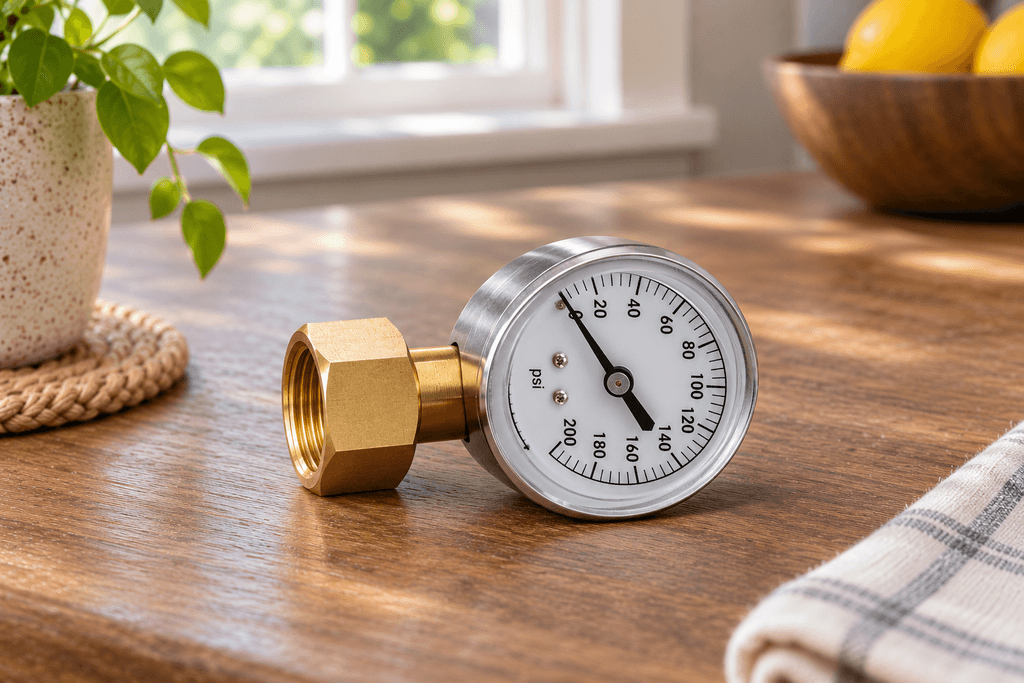
A water pressure gauge that screws onto an outdoor hose bib turns a vague complaint into a number in thirty seconds, and the number tells you most of what you need to know. Under 40 psi is low, and the cause is a partly closed valve, a failing regulator, corroded pipes, a leak, or a well system that needs attention. From 40 to 60 is normal. From 60 to 80 is on the high side and worth watching. Over 80 exceeds what plumbing code allows without a pressure reducing valve, and it strains the water heater, the appliance hoses, and the supply lines until one fails. A reading that drifts while nothing is running points to a regulator that is in the middle of failing.
Durham homes split between city water and wells, and the gauge reads both. Here is what each range means and what to do about it.
How to Take the Reading
Screw the gauge onto an outdoor hose bib or the washing machine’s cold supply with every fixture in the house off, and read the static pressure. Then have someone open a faucet inside and read it again under flow. A static reading in the normal range that drops only a little under flow is healthy. A large drop under flow with a normal static reading points to a restriction in the pipes. A static reading that moves on its own, with nothing running, points to the regulator or, on a well, the pressure switch.
Under 40 psi: Low
Low everywhere, all the time, has a short list of causes. The main shutoff valve or the valve at the meter may have been left partly closed after plumbing work, and that is the first check because the fix takes seconds. A pressure reducing valve, the bell-shaped fitting on the main line, may be set too low or clogged with sediment. Corroded galvanized steel pipes, common in Durham homes built before the 1960s from Trinity Park to the mill villages of East and West Durham, close up from the inside over decades, worst on the hot side. And a leak diverts water before it reaches the fixtures, which is why low pressure paired with a water bill that climbed without explanation usually means one leak is behind both.
Low at one fixture only is a different and easier case: a clogged aerator or showerhead, or a supply stop under the sink left half open. Clean the aerator, soak the showerhead in vinegar, and open the stop fully before looking further.
40 to 60 psi: Normal
This is where a home should sit. Showers feel strong, appliances fill at the rate they were designed for, and the water heater, hoses, and valves are not under strain. If the number is normal and the pressure still feels weak, the problem is flow rather than pressure, which points to a restriction in a specific line, a water heater losing output on the hot side, or a fixture cartridge that needs replacing.
60 to 80 psi: High Side
Pressure in this range works, but it wastes water at every fixture, shortens the life of toilet fill valves and appliance hoses, and often produces water hammer, the bang when a valve closes quickly. If the home has a pressure reducing valve, a plumber can set it to a measured target in the normal range. If it does not, this is the range where adding one starts to pay for itself in fixture life.
Over 80 psi: Too High
Plumbing codes call for a pressure reducing valve wherever the supply exceeds 80 psi, because pressure above that strains the water heater tank every time it heats, bursts appliance hoses, and forces relief valves to drip. Durham’s hilly terrain puts homes at the bottom of a slope under far more pressure than homes at the top of the same street, and a failed or missing regulator in a low-lying home can read well above 100. The fix is a new or replaced pressure reducing valve set to a safe level, and the water heater’s relief valve and expansion tank should be checked at the same time.
A Drifting Reading? The Regulator Is Failing
A pressure reducing valve lasts roughly ten to fifteen years, and a failing one drifts instead of holding its setting. The gauge reads 55 in the morning and 75 by evening, or moves while nothing is running. That drift is the sign to replace it before it fails fully in one direction or the other.
Homes on Wells
Many homes in rural Durham, Orange, Chatham, and Alamance counties draw from a well, and the gauge reads the well system instead of a utility. A well cycles between a low and a high setting, often 40 and 60 psi, as the pump fills the pressure tank and shuts off. Pressure that surges and fades while a tap runs, or a pump that starts and stops every few seconds, points to a waterlogged pressure tank, a failing pressure switch, or a worn pump. Low pressure that has crept down over years points to a clogged sediment filter, scale in the pipes from hard well water, or a pump losing capacity. Our well pump service covers the pump, the tank, the switch, and the filtration that well homes depend on.
Fixes by Cause
- A partly closed valve: open it fully, and replace a stiff gate valve with a ball valve.
- A failing or missing pressure reducing valve: install or replace it and set it to a measured target.
- A clogged fixture: clean the aerator or showerhead, or replace a worn cartridge.
- Corroded galvanized pipe: repiping the affected runs, because no cleaning reopens a pipe that has closed from the inside.
- Hard well water scale: a water softener stops the buildup from continuing. Durham’s municipal water is on the softer side, so heavy scale usually points to a well.
- A hidden leak: leak detection locates it before anything is opened.
- A well system: pressure switch, tank, or pump service.
Getting an Accurate Diagnosis
Happy Home Services has been Durham’s trusted heating and air experts since 1955, and our plumbers start a water pressure assessment with the gauge rather than a guess, then explain what the number means for your home with honest, upfront pricing for any repair. Pressure problems another company could not pin down are the ones we are called for most. Schedule online any time or reach our team through 24/7 website chat, and we will get dependable pressure back at every tap.
Frequently Asked Questions
Why does my well pump run constantly?
A pump that never shuts off cannot reach the pressure switch’s cutoff setting, which points to a leak in the system, a pressure switch set too high, a failing pump, or a well that is running low. A pump running continuously burns itself out, so shut off its breaker and call. The diagnosis starts at the pressure tank and the switch.
Can I turn up the pressure reducing valve for a stronger shower?
The adjustment screw on top raises the setting, and a plumber can set it anywhere in the normal range with a gauge attached. Raising it above 60 psi trades a stronger shower for shorter appliance and fixture life, and raising a valve that no longer holds a setting does nothing. A weak shower with normal static pressure is usually a flow problem at the showerhead or the hot water side.
Does a tankless water heater lower water pressure?
A tankless unit adds a small restriction and a flow sensor to the hot side, which most homes never notice, and a unit that is undersized or scaled up can reduce hot water flow noticeably. Pressure on the cold side is unaffected. Annual descaling keeps the hot side flowing as designed.
What pressure should a well system be set to?
Most residential pressure switches are set to cycle between 40 and 60 psi, which gives steady pressure at the fixtures and lets the pump rest between cycles. Settings of 30 to 50 are common on older systems and feel weaker. A plumber can raise the switch setting within the pump’s and tank’s ratings, and the tank’s air charge is set to match.
Why is my pressure fine in the morning and weak in the evening?
Pressure that drops in the evening on city water points to neighborhood demand during peak hours, especially in summer when irrigation runs, or to a pressure reducing valve that drifts under changing supply pressure. On a well, it points to the pump or tank struggling to keep up with evening use. A gauge reading taken at both times shows which.